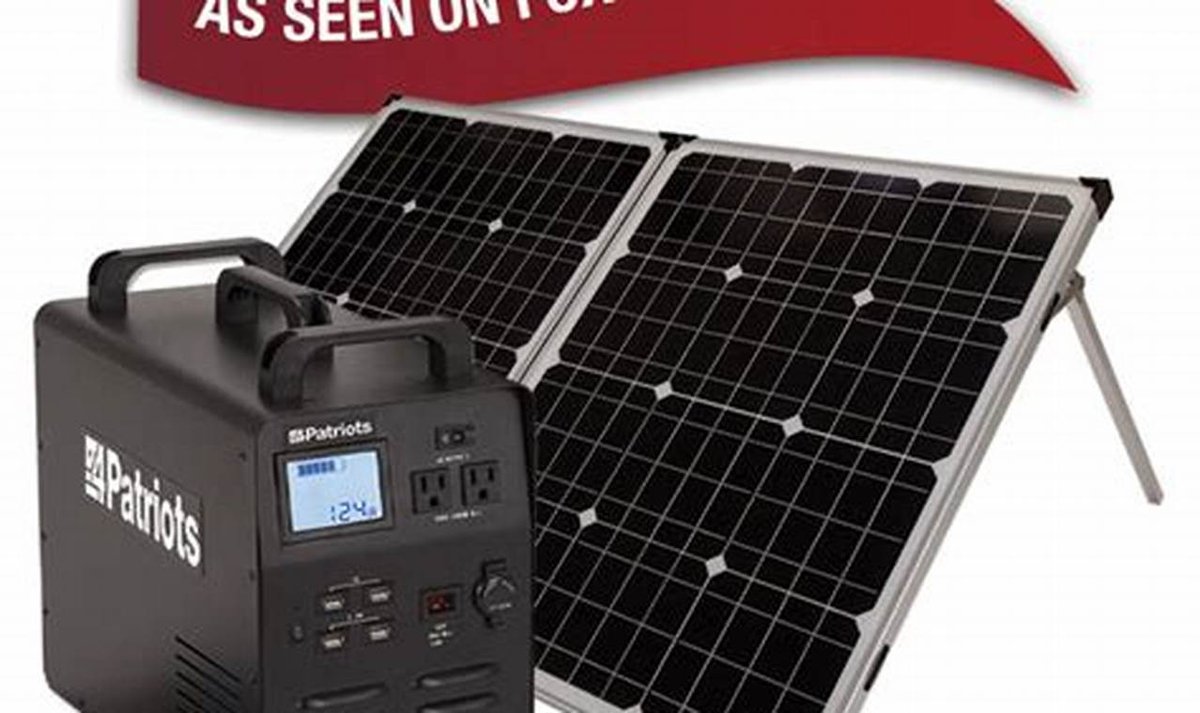
In an unpredictable world, losing power isn't just an inconvenience; it can be a genuine threat to your comfort, safety, and even survival. Whether it's a ferocious storm, an aging power grid, or unforeseen circumstances, a reliable generator can be your most valuable asset, offering peace of mind and protection when the lights go out. But with so many options on the market, how do you navigate the landscape of 4Patriots vs. Competitor Generators: Price & Features to find the right fit for your needs?
This guide cuts through the marketing noise to give you a clear, journalist's eye view of what 4Patriots offers, how it stacks up against the competition, and what truly matters when you're investing in emergency power.
At a Glance: What You Need to Know
- Generators are crucial: Essential for power outages, offering peace of mind and protection.
- Solar is king for emergencies: Fume-free, quiet, and safe for indoor use, unlike gas generators which pose carbon monoxide risks.
- 4Patriots Focus: Primarily portable, solar-powered generators like the Power Generator 1800 and 2000X.
- Key Consideration for 4Patriots 1800: Retails around $2,497.00. Offers 1,800 continuous watts, 768Wh battery. Noted for its eco-friendliness and included accessories, but customer feedback highlights concerns about price-to-spec ratio, limited outlets, and solar charging speed compared to some competitors.
- 4Patriots 2000X Upgrade: Provides more outlets and expandability, designed for slightly heavier-duty essentials.
- Competitor Landscape: Many portable generators, especially solar, fall into the $1,500-$3,000 range, often offering higher solar input or more outlets for the price.
- Your Decision: Hinges on your specific power needs, budget, desired portability, and long-term value.
Why Generators Matter: Your Lifeline in a Crisis
Imagine this: The wind howls, the rain lashes down, and suddenly, your home is plunged into darkness. No lights, no refrigerator, no way to charge your phone or medical devices. This isn't just an inconvenience; it's a scenario that highlights the absolute necessity of a reliable power source. A generator isn't a luxury; it's a fundamental part of a comprehensive preparedness plan. It keeps your food from spoiling, your communication lines open, and crucial medical equipment running. For many, it's the difference between merely enduring an outage and truly safeguarding their family.
Before You Buy: Core Considerations for Any Generator
Choosing the right generator means understanding your needs first. Here’s a breakdown of the critical factors you should weigh:
What Are Your Power Needs? The Home Inventory Checklist
Before you even look at generator specs, grab a pen and paper. Walk through your home and list every essential item you'd need during an outage: lights, phone chargers, laptops, a refrigerator, perhaps a microwave for quick meals, a space heater, an electric blanket, or a CPAP machine.
For each item, note its wattage (usually found on a label or in the manual). This "home inventory" gives you a clear picture of the continuous power output and peak output your generator needs to handle. Remember, you might not power everything at once, but you'll want the flexibility to rotate or prioritize.
Power Source: Solar vs. Gas – A Clear Choice for Safety and Convenience
The type of fuel your generator uses is arguably the most critical decision, impacting safety, usability, and environmental footprint.
- Gasoline Generators: These are often powerful and readily available, but they come with significant drawbacks. They must be kept outdoors due to the deadly risk of carbon monoxide poisoning. They're heavy, require you to store and transport flammable fuel, and can pose a fire hazard. Plus, fuel availability can be a major issue during widespread emergencies.
- Solar-Powered Generators (Portable Power Stations): These are, simply put, the ideal solution for many emergency scenarios. They capture free energy from the sun (or charge from a wall outlet before an outage), produce zero fumes, and operate silently. This means they are perfectly safe for indoor use, making them invaluable in adverse weather or urban environments where outdoor placement isn't feasible or safe.
Portability: More Than Just Moving It Around
While full home standby generators are fixed installations, most people need a portable solution for emergencies. How portable do you need it to be?
- Weight: An ideal portable solar generator should be light enough for easy movement—think around 60 pounds or less. This makes it suitable for car transport, carrying it a short distance to a safe room, or even taking it camping, boating, or tailgating when there's no emergency.
- Dimensions: Can it be discreetly stored? Can it fit in your car trunk if you need to evacuate?
Noise, Smell, and Discretion: Why Silence is Golden
In a survival situation or during civil unrest, a loud, smelly gasoline generator can draw unwanted attention—and not the good kind. Solar-powered generators, operating silently and producing no fumes, offer a distinct advantage here. They allow you to maintain power without broadcasting your location or creating unpleasant indoor air quality.
The Price Tag: Understanding the Investment
Generators represent a significant investment in your preparedness. Full home standby generators can run into the tens of thousands, but portable emergency generators typically fall into the $1,500 to $3,000 range. When evaluating the Current 4Patriots generator price or any other brand, consider not just the upfront cost, but the value you're getting in terms of features, power output, battery capacity, and included accessories. Financing options, like the Klarna Pay in 4 that 4Patriots offers, can help make these essential purchases more accessible.
Diving Into 4Patriots Generators: What They Offer
4Patriots has established itself as a well-known name in the preparedness space, offering a range of products, including their solar-powered generators. Let's break down their popular models.
The 4Patriots Power Generator 1800: A Closer Look
The Patriot Power Generator 1800 (PPG 1800) is often a first consideration for those exploring solar-powered emergency solutions.
Price Point and Value Proposition
Retailing at $2,497.00, the PPG 1800 sits comfortably within the typical price range for portable solar generators ($1,500-$3,000). However, as we'll see, its specifications sometimes lead customers to question its value proposition when compared to competitors offering more power or features for a similar investment. Always check the current 4Patriots generator price as promotions and bundles can affect the final cost. Financing through services like Klarna is available, which can ease the initial burden.
Power Output & Battery Life: Specs vs. Real-World Use
The PPG 1800 offers:
- Continuous Power Output: 1,800 watts
- Peak Output: 3,048 watts (for brief surges, like starting a refrigerator motor)
- Battery Capacity: 768Wh (watt-hours) or 60Ah (amp-hours)
- Battery Life Cycles: Over 2,500 recharge cycles, indicating good long-term longevity.
What does this mean in practical terms? 4Patriots suggests it can power a full-size refrigerator for up to 6.4 hours. While this is helpful, it's crucial to remember that this assumes only the refrigerator is running and that its compressor isn't cycling constantly. Real-world usage with multiple devices will significantly reduce runtime.
Charging Options: Sun vs. Wall Outlet – The Time Factor
Flexibility in charging is key for any emergency generator. The PPG 1800 offers two primary methods:
- AC Wall Outlet: A full charge takes approximately 3 hours, which is quite efficient and allows for quick top-ups before an anticipated outage.
- Solar Panels: Under ideal conditions, using solar panels will take about 10 hours for a full charge. The generator uses MPPT (Maximum Power Point Tracking) technology, which optimizes solar charging efficiency by adjusting to varying light conditions. However, a significant limitation is its maximum solar input of 240 watts. Many competitors in this price range can support up to 1,000 watts of solar input, which translates to much faster charging, especially considering the average U.S. gets only 5-6 hours of peak sunlight per day. This means relying solely on solar for a quick recharge after significant depletion might be challenging.
Portability & Design: 40 Pounds of Preparedness
Weighing in at 40 lbs, the PPG 1800 is certainly portable enough for car transport and moving around your home. It's not designed for long-distance hiking or rapid, on-foot evacuation, but it's manageable for most short-distance relocation needs. It lacks a car charger input, which could be a drawback for charging on the go during an evacuation.
Outputs: Connecting Your Essential Devices
The PPG 1800 provides:
- 2 AC outlets
- 4 USB ports
- 1 DC output
While the USB ports are ample for small electronics, having only two AC outlets can be limiting if you need to power multiple standard appliances (like a fridge and a microwave, or a space heater and a CPAP machine) simultaneously. This often requires careful power management and prioritizing devices.
Eco-Friendly Credentials: Silent and Clean Power
One of the PPG 1800's strongest selling points is its commitment to eco-friendliness. It operates silently, produces zero emissions, reduces reliance on fossil fuels, and incorporates sustainable materials. This makes it an excellent choice for indoor use, quiet neighborhoods, and anyone committed to reducing their carbon footprint.
The Perks: Included Accessories
4Patriots often sweetens the deal with a generous bundle of accessories. The PPG 1800 typically includes:
- A 100-watt folding solar panel
- A 25 ft extension cord
- A survival food kit
- A water purification kettle
- A flashlight
- A solar lantern
These additions enhance its emergency preparedness value, offering more than just power.
Customer Sentiment & Drawbacks: What Users Are Saying
Average customer ratings for the PPG 1800 hover around 3.0 out of 5 stars, based on feedback from dozens of users. Common concerns echo our analysis:
- High price relative to specifications: Many feel similar or better specs are available for less.
- Weight hindering mobility: While portable, 40 lbs isn't featherlight for all scenarios.
- Limited AC outlets: A frequent complaint for those needing to power several appliances.
- Real-world battery capacity shortcomings: Users sometimes find the battery drains faster than anticipated, especially under continuous load.
- Slow/insufficient solar charging efficiency: The 240-watt input limit is a major factor here, making full solar recharge time-consuming.
Stepping Up: The 4Patriots Power Generator 2000X
The 4Patriots Power Generator 2000X is designed as an evolution, addressing some of the limitations of the 1800 model, making it suitable for a broader range of important devices like phones, space heaters, fridges, and CPAP machines.
Enhanced Power & Connectivity: More Outlets, More Possibilities
A key upgrade in the 2000X is its expanded connectivity. It features four AC outlets (double the 1800 model) and four charging ports. This significantly improves its versatility, allowing you to power more devices simultaneously without constant swapping.
Improved Portability & Expandability
The 2000X weighs approximately 60 pounds. While heavier than the 1800, it's still considered portable and suitable for discreet storage. A notable advantage is its expandability: you can daisy-chain additional solar panels, theoretically allowing for more power intake and faster charging times, though specific input limits would need to be checked.
Quiet, Clean Operation: A Consistent Benefit
Like its smaller sibling, the 2000X maintains the core benefit of operating quietly and producing no emissions. This ensures it remains safe for indoor use and won't attract unwanted attention. It also comes with an essential 25-foot extension cord, allowing you to place solar panels outside while keeping the generator safely indoors.
4Patriots vs. The Field: Where Do Competitors Stand?
When comparing 4Patriots generators to the broader market of portable solar power stations, a few key differentiators emerge.
Price-Performance Comparison: Finding the Sweet Spot
Many competitors in the $1,500-$3,000 range offer compelling alternatives. For a similar price as the PPG 1800 ($2,497), some competitor units might boast:
- Higher continuous wattage: 2,000W, 2,200W, or even more.
- Larger battery capacity: 1000Wh, 1500Wh, or beyond.
- More AC outlets: Often 3-6 AC outlets, providing greater flexibility.
- Faster solar charging: Crucially, many support 500W-1000W of solar input, significantly reducing recharge times.
The key takeaway here is to not just look at the dollar amount, but what that dollar amount buys you in terms of raw specifications and features. Sometimes, paying a bit more (or even the same) for a competitor can yield substantially better performance metrics, particularly in battery capacity and charging speed.
Solar Charging Efficiency & Capacity: A Key Differentiator
This is perhaps the most significant area where 4Patriots generators, particularly the 1800, face stiff competition. The 1800's 240-watt solar input limit means it will take considerably longer to recharge via solar than units that can accept 500W, 800W, or even 1000W of solar input. Given that optimal sunlight is limited to 5-6 hours a day, higher input capacity translates directly to practical usability during an extended outage. If rapid, reliable solar recharging is a top priority, carefully compare the maximum solar input across brands.
Output Versatility: More Ports, More Power?
While the PPG 2000X improves with four AC outlets, the PPG 1800's two AC outlets can be restrictive. Competitors often offer a wider array of ports (more AC, USB-C Power Delivery, 12V car ports with higher amperage) which adds to overall utility, especially if you have many diverse devices to power.
Weight & Design: For the Homebody or the Nomad?
4Patriots generators are built to be portable. At 40 lbs (1800) and 60 lbs (2000X), they are manageable for most domestic scenarios. However, the market also offers lighter, more compact units for extreme portability (at lower power outputs) or heavier, wheeled units for maximum power and easier movement over flat surfaces. Consider your primary use case: emergency home backup, car camping, or potential evacuation scenarios.
Making Your Decision: Beyond the Spec Sheet
Choosing the right generator isn't about finding the "best" one overall, but the "best" one for you.
Your Personal Power Profile: Matching Needs to Output
Revisit that home inventory. Do you only need to keep phones charged and a few lights on? Or do you need to cycle a refrigerator, run a CPAP machine, and power a microwave?
- Minimal Needs: A smaller, less powerful (and often less expensive) unit might suffice.
- Moderate Needs: The 4Patriots 1800 or 2000X could be a good fit, particularly for essential appliances, with careful power management.
- Extensive Needs: You might need to look at units with higher continuous wattage (2500W+) and significantly larger battery capacities (1500Wh+), which will likely push you towards the higher end of the portable generator price range or even larger systems.
Budgeting for Preparedness: Payment Plans and Long-Term Value
While the upfront cost is important, think about the long-term value. A generator that sits unused but works flawlessly when needed is worth its weight in gold. Consider financing options if the lump sum is a barrier. Also, factor in what's included. 4Patriots' bundled accessories, like the solar panel and survival gear, add tangible value that might offset a slightly higher price point compared to a barebones competitor.
Future-Proofing Your Investment: Expandability and Durability
Can the generator grow with your needs? The 4Patriots 2000X offers expandability with additional solar panels, which is a great feature. Look for robust build quality, a long cycle life for the battery, and good warranty coverage. A generator is a long-term investment, so durability matters.
The "Hidden" Costs: Fuel, Maintenance, and Peace of Mind
For solar generators, "hidden costs" are minimal compared to gasoline models (no fuel to buy, no oil changes). The main "cost" is ensuring the battery is topped off and maintained according to manufacturer guidelines. The greatest value, however, is the peace of mind. Knowing you have a reliable power source can alleviate immense stress during an emergency—a priceless benefit that no spec sheet can fully capture.
Your Next Steps to Power Preparedness
You've explored the landscape of 4Patriots vs. competitor generators, understanding the nuances of price and features. Now, it's time to act.
- Re-evaluate Your Needs: With the insights gained, take a fresh look at your personal and household power requirements. Prioritize what must run during an outage.
- Compare Specific Models: Don't just look at brands; compare specific models side-by-side, paying close attention to continuous wattage, battery capacity (Wh), solar input limits, and the number of AC outlets.
- Read Recent Reviews: Product specifications are one thing, but real-world user experiences (like the feedback on the PPG 1800) offer invaluable insights into performance, reliability, and customer service.
- Consider Bundles & Promotions: Many companies, including 4Patriots, offer seasonal deals or bundles with accessories. These can significantly enhance the value of your purchase.
- Invest in Peace of Mind: Ultimately, a generator is an investment in your safety and comfort. Choose the option that best empowers you to face the unexpected with confidence.
By taking these steps, you'll be well-equipped to make an informed decision and secure the essential power you need when it matters most.